
collaborative producing toolkit:
chapter 3: How Much Can You Save? Why Some Co-Productions Save More Than Others
It depends. There is no simple formula for calculating the cost savings from a Co-Production because every project and partnership is different. The savings a particular Co-Production might generate depend on the specific relationship, production, budget, and schedule, as well as the many decisions made along the way.
To better understand the range of potential savings, we sought Co-Production budgets from a cross-section of theaters and collected 54 budgets for analysis. We focused on the Originating Theater’s Shared Costs, primarily physical production and rehearsal costs, compared with the Receiving Theater(s)’ Balancing Payment. This allowed us to approximate the difference between what it might cost the Originating Theater to build and rehearse the production on its own and its net cost when those expenses were shared through a Co-Production.
Because the budgets varied widely in scale, theater size, and production needs, we focused on the percentage of Net Savings rather than the actual dollars saved.
Originator’s Shared Cost/ Receiver’s Balance Payment = Percentage saved
The table below summarizes the percentage saved across the 54 Co-Production budgets, grouped by the relative contract structures used by the participating theaters.
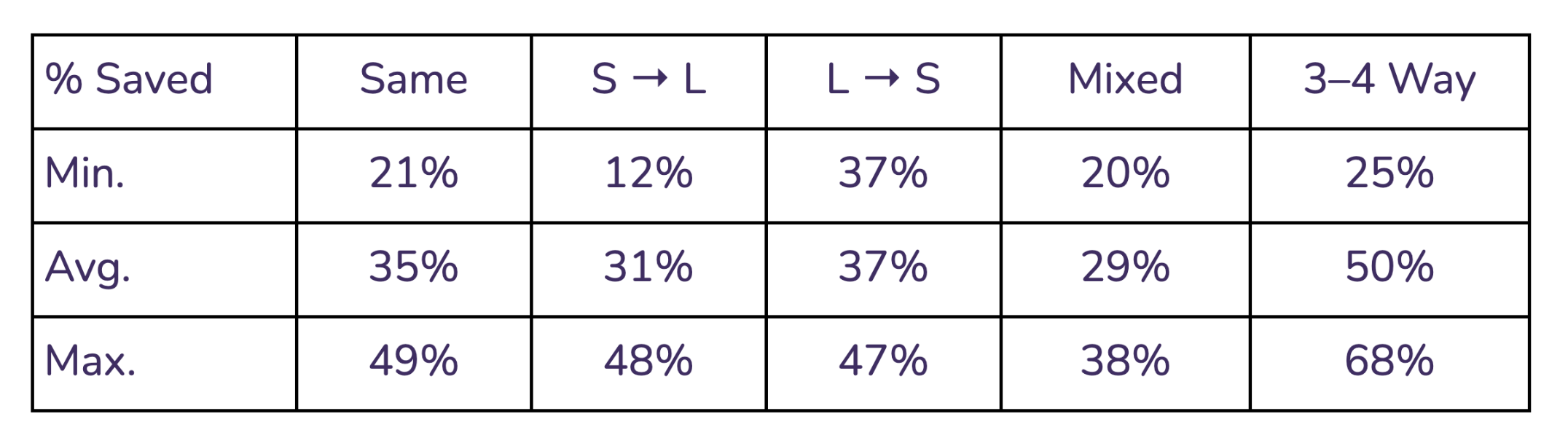
Contract categories: Same = equivalent contracts; S → L = smaller to larger contract; L → S = larger to smaller contract; Mixed = other contract combinations.
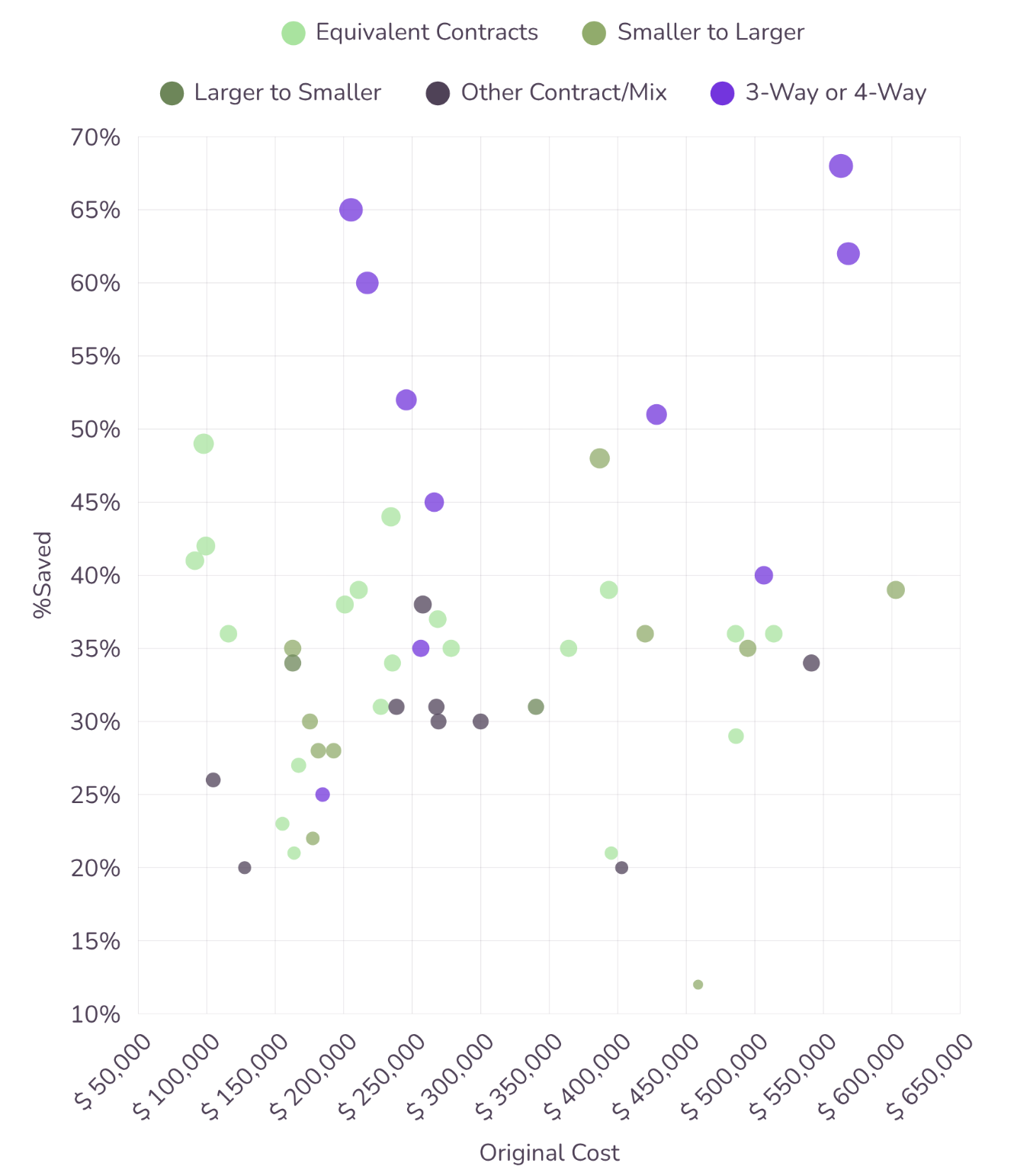
The graphic that follows shows the same 54 budgets individually. Each dot is positioned horizontally according to the Originating Theater’s Shared Costs and vertically according to the percentage saved, with the dots identified by the contract structures used for each leg of the Co-Production.
As the range of results suggests, the savings generated by a Co-Production can vary considerably. Several factors can drive or limit those savings:
Larger Casts - Typically yield bigger shared rehearsal cost benefits, but those can be limited or even erased if one or both theaters are required to house more actors than they typically would for their runs, especially if a theater's weekly housing costs match or even exceed actor salaries.
Bigger Productions - The larger the scale or more expensive the production is to mount the more expenses there are to split, however, each theater's running costs can put a dent in those savings which can be especially onerous if a theater ends up housing more actors than they would otherwise because of the Co-Production.
Schedule - A concise schedule can eliminate storage costs and by offering actors continuous employment it can often help avoid cast changes and the need to re-rehearse.
If, as our survey suggests, saving money is a primary reason theaters choose to co-produce, it is important to be strategic in selecting both the Co-Production partner and the project. In Chapter 7, we provide considerations for choosing a compatible partner, but finding a good match is only the first step. Establishing a clear structure, budget, and schedule that works for all parties, and maintaining a disciplined approach to that plan, is essential to maximizing savings.